
This quiant and wonderful place is located at 193 Celyon Road at the Eurasian community house, the ambience is comforting and the food is delicious. Dinner at this charming place was pretty decent. We ordered the Chicken Curry Devil ($16.80), Fried Ocra ($7) and Curry Moolie with Prawns ($13.80).
The Chicken Curry Devil is a mix of cocktail sausages, chicken, cabbage and assorted veg in a red sourish curry sauce. The Curry Moolie dish contained brinjal and prawns cooked in a lemak sauce. There is a choice of prawns or mackarel. The curries are actually not that spicy as we had pre-assumed. The Ocra was bascially lady's fingers stir-fried with some indian spices but it was lovely. In my opinion these are great dishes to go with piping hot rice. We really enjoyed the Ocra and the Curry Moolie. Unfortunately, we became too stuffed for desserts.
The menu has a wide selection of appetizers and western stuff such as Chicken Wings, Sheperd's Pie, Calamari, etc. Serivce was decent though I have to say the food took quite a while to come... but then again they've already "excused" themselves on the main page of their menu by indicating that food ordered are freshly prepared and would take 15-20mins, and fish keropok is complimentary while you wait. An overall enjoyable dining experience! Will make room for the Sugee Cake the next time I ever go there.
History of Eurasians
The community of Eurasians in Singapore is descended from Europeans who intermarried with local Asians. The ethnicities within the community span the length and breadth of Europe, although Eurasian migrants to Singapore in the 19th century came largely from colonies already in Asia, such as British Malaya; Chittagong and Goa in India; the Dutch East Indies and French Indochina.
Spoken language
English is generally spoken as a first language by Eurasians, whilst amongst the elder generation who are of Portuguese descent the Portuguese creole known as Cristão or Papia Kristang – the Kristang language – is still spoken by some people.
Religion
The Eurasian community in Singapore is overwhelmingly Christian, most being Roman Catholics of Portuguese descent who celebrate Christian feast days such as Christmas, Easter and Corpus Christi.
Cuisine
Foods commonly associated with Eurasian culinary traditions include devil's curry (curry debal in Kristang), curry feng, Eurasian smore (a beef stew), mulligatawny soup (mulligatani in Kristang), shepherd's pie and vindaloo (vin d'arlo in Kristang).
Currently, the community boasts family names which come from:
The Armenian (the Galistan, the Dragon and the Avakian families)
British (the Caine, the Hogan, the Reeves, the Fenley, the Hale, the Shirlaw and the Smith families)
Danish (the Lange, the Olsen, the Rasmussen and the Jensen families)
Dutch (the Marbeck, the Van Cuylenberg, the De Bakker, the Westenra, the Ten Haken, the Feenstra, the Gronloh and the Vanderstraaten families)
French (the Longue, the Poulier and the Cherbonnier families)
German (the Oehler, the Keller, the Kaiser and the Roelcke families)
Italian (the Marini, the De Luca, the Esposito, the Angelucci and the Scarpa families)
Portuguese (the Carvalho, the Conceicao, the De Almeida, the De Silva, the De Souza, the Lazaroo, the Monteiro, the Oliveiro, the Pereira, the Pestana, the Rodrigues and the Theseira families)
Spanish (the Castellano, the Fernandez, the Lopez, the Zuniga and the Hernandez families)
Swedish (the Holmberg, the Johansson and the Lindblom families)
Reference:
http://en.wikipedia.org/wiki/Eurasians_in_Singapore
Showing posts with label Culture. Show all posts
Showing posts with label Culture. Show all posts
Saturday, November 21, 2009

Friday, November 20, 2009
Indian - Little India
Background on Indian Culture
As the name suggests, it is easy to infer that the Indian culture is brought about by India. India itself is the site of a civilization as ancient as any in the world. City states arose in North India, along the Indus River, at about the same time as the early civilizations of the Tigris-Euphrates at Sumer and other locations. Over the centuries, India was invaded by many different colonies, all of whom left their imprint and culture into today’s Indian society. In the religious context, Hinduism could be said to be the most “followed” religion among the Indians, even for today. Hinduism is formed by an array of local gods, goddesses, and heroes. Gradually these gods were given a coherent framework, in which the individual deities were seen as manifestations of a greater unity. Nonetheless, they remain a major feature of Hinduism, as it is of Indian culture in general.
Trip to Little India


As the name suggests, it is easy to infer that the Indian culture is brought about by India. India itself is the site of a civilization as ancient as any in the world. City states arose in North India, along the Indus River, at about the same time as the early civilizations of the Tigris-Euphrates at Sumer and other locations. Over the centuries, India was invaded by many different colonies, all of whom left their imprint and culture into today’s Indian society. In the religious context, Hinduism could be said to be the most “followed” religion among the Indians, even for today. Hinduism is formed by an array of local gods, goddesses, and heroes. Gradually these gods were given a coherent framework, in which the individual deities were seen as manifestations of a greater unity. Nonetheless, they remain a major feature of Hinduism, as it is of Indian culture in general.
Trip to Little India
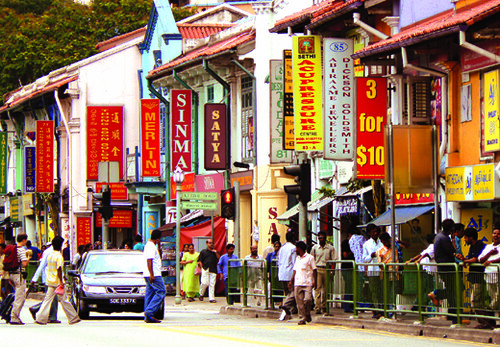
For this visit, our group has decided to take the MRT down from Pasir Ris station to Little India station. After we came out of the station and proceeded on to Serangoon Road, the distinct smell of Indian perfume was already lingering in the air. Around us was filled with undulating music punctuated by car horns and bicycle bells, women drifting along in vivid saris and the pungent nose-tickling aroma of spices. At first, we all felt irritated with the endless rubbing of shoulders with other visitors and also, the perfume was too overpowering for us.
From the above picture that we've taken, it is easy to tell that this is a haven for the Indians. There are rows and rows of shops selling from fresh groceries to saris and even luxury gold items. This is the place where they can find all their shopping needs. For us, we stop by one of the shops to purchase some local Indian chips for a price of $2 only! After that, we began walking down the streets, visiting shop by shop. However, the hot sun forced us to cut our journey short and head for lunch. Even though the streets were really packed, it is a breeze to find good Indian food along the way.There are a wide selection of North Indian and South Indian fares to select from. Some are so famous that we've even seen it appear in magazines before. After scouting for about 15 minutes, we settled on a restaurant called Khansama Tandoori Restaurant. The dishes we ordered ranged from seekh kebab to mutton curry to garlic naan (garlic bread). And the best part of this restaurant is? The prices are cheap! For example, the mutton curry that we ordered cost a mere $6.50 while the garlic naan costs $3 only. Its easy to say that this restaurant is probably the one of the few in Singapore which offers good food at really low prices.
After a hearty meal, we have no problems to continue to explore the place. We love to stop and watch the henna works of the artist . It's such a beautiful paint of artwork on the limbs without the pain from tattoo. One of us even got it for a price of $5! After that, we decided to visit the famous 24 hours shopping centre in Little India called Mustafa. The setting of the shopping centre is very much different from what you can find in Orchard Road or Tampines Mall. They have many different shops that sells electronic gadgets, clothings, sports equipments as well as home equipments. In there, it is actually possible to bargain with some shopkeepers over the prices of the goods. As it was all our first time visiting Mustafa, we were taken aback when we realised there were so much stuffs to buy from there. Unfortunately, we didn't bring enough money.
When nightfalls, the place lighted up with colours so unique that one will certainly feel enchanted. As the weather turns cooler, it is easy to spot groups of men having a small picnic on the empty field. Unfortunately for us, we didn't get to visit the famous The Sri Veerama Kaliamman Temple as it was getting late. At about 9pm, our group has decided to call it a day and head back for a rest.
A tip for all of you : dress casually to Little India!
Thursday, November 19, 2009
Malay - Kampong Glam
Yesterday, our group made a trip down to..

Kampong Glam!
To start off, I'd like to give some background information of the Malay Culture and Kamong Glam - In Malay, the word "Kampung" means "village or settlement" and "Glam" is the name of a particular tree, which grew in abundance in the area in early Singapore. In the beginning, Kampong Glam was a fishing village situated at the mouth of Rochor River. It became more populated and grew into prominence after the Sultan of Singapore, Hussein Mohammed Shah and the Temenggong signed a treaty with the East India Company in 1819.

Above is the Sultan Mosque
Unique Characteristics of Kampong Glam
There is a variety of rich heritage passed down from generation to generation. Some of these long enduring traditions are in the form of monuments, trades, cultures and practices. Conservation of places of worship, old school, old dwellings, some of which are still in their original form while others have been refurbished. These rich remains give a hint of the architecture and life style of the early days. Such diverse rich heritage can only come about through a sense of tolerance, sharing and bonding, all encapsulated in the Kampong Glam spirit.
Walking down the streets, we realized that like Little India and Chinatown, Kampong Glam has been restored, refurbished and new life breathed into it, bringing back the former colour and vibrancy of the area. We found rows of conserved shophouses in Arab Street, Baghdad Street and Bussorah Street. Many of these shophouses have new tenants such as design and IT firms, art galleries, crafts and curios shops, food caterers and restaurants. They blend in with traditional businesses like textile and carpet shops, blacksmiths and shops selling religious items used by Muslims which we found amazing because in this way, the modern culture and traditional one(s) can actually co-exist! It is also an area of good restaurants, from Malaysian coffee shops and bakeries to fine modern European dining, like Le Pont De Vie. Sadly, we didn't manage to get a taste of these delicacies ):

Reference: http://www-singapore.com/kampong-glam/index.html
Wednesday, November 18, 2009
Chinese - Chinatown
When we first arrived at Chinatown, we were amazed at the hustle and bustle of Chinatown. Chinatown is a colourful cultural hub that is packed with shopping and eating areas. Antique shops abound, selling everything from furniture to small antiques and jewellery. There is a wide variety of boutique hotel as well as Chinese medical halls.

Chinatown
We first started by walking in the Chinatown Street Market (牛车水街市). Here, we found ourselves immersed in a vibrant and lively traditional atmosphere accompanied with modern style. It is full of nostalgia especially for the older generation, as items sold here are authentically Chinese. One thing that we all know that is famous in Chinatown is the bargaining part! All of us really had fun haggling prices with the shopkeepers. One of us even managed to buy a scarf at $2!
After a few hours of walking (and bargaining), we settled at the Chinatown Food Street (牛车水美食街) for a feast. All of us ordered several local dishes. The dishes ranged from fishball noodles to laksa to barbequed seafood to desserts like sweet glutinous rice ball. The food was salivating and simply delicious - 5/5 stars! The average price for a meal here ranges from as low as $3 to $12. A bowl of noodles would cost about $3 and a plate of barbequed seafood would cost about $12.

Chinatown Food Street
Whilst walking, we spotted various places of interests. The Chinatown Heritage Centre that holds precious history of Chinatown, Singapore's oldest Hokkien temple- Thian Hock Keng and the Sri Mariamman Temple which is Hindu. Unfortunately, we did not have time to go into these places but we will definitely be back again. Since we do not know what is inside these places of interests, you can head down to Chinatown to check it our yourselves!

Thian Hock Keng Temple
Also, we found out unique characteristics of Chinatown by talking to some of the shopkeepers. Chinatown's is locally known as Niu Che Shui (Bullock Cart Water). In the past, conditions were not favourable and harsh. The only sources of fresh water were available from the wells of Ann Siang Hill and Spring Street. Households had to collect fresh water in bullock-drawn carts. That was how Chinatown's local name came about. Chinatown is also pronounced is many different ways due to the diverse dialect groups such as Hokkeins, Teochews and Cantonese.
After a long day of walking, we were all very tired so here is a tip for all of you: Always remember to wear comfortable shoes!
Reference:
Subscribe to:
Posts (Atom)